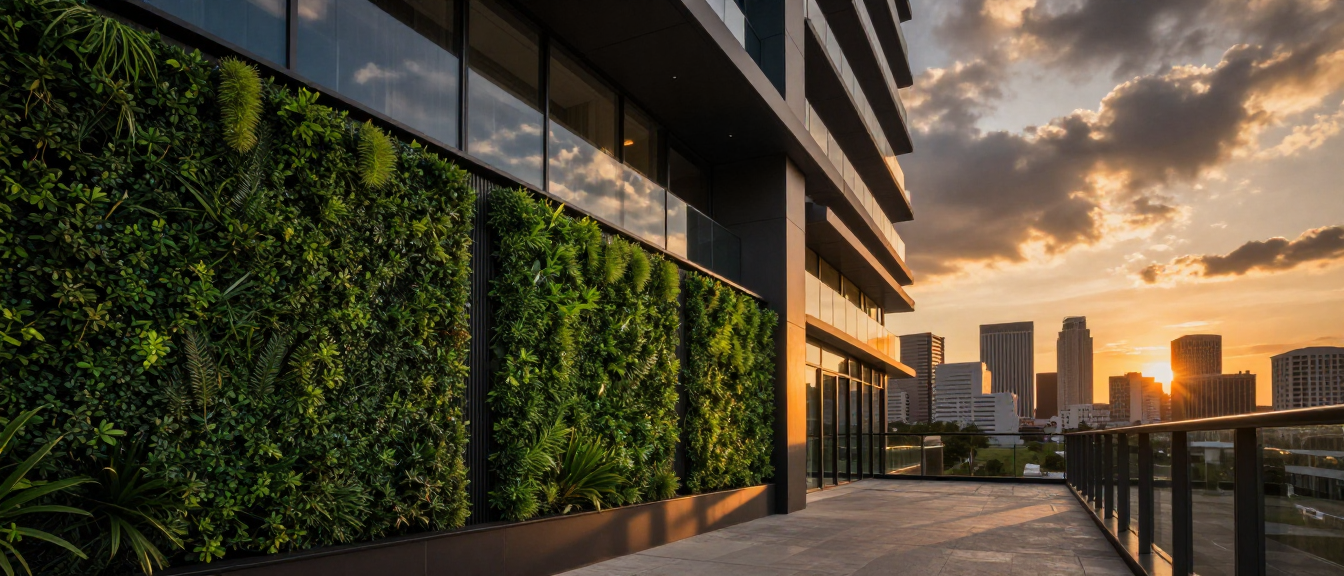
If you're installing artificial greenery in a commercial building in Texas—an office, restaurant, hotel, multifamily property, or retail space—fire code is part of the conversation. But figuring out exactly what's required isn't always straightforward, because Texas doesn't have a single rule that says "artificial plants must be fire-rated in all commercial buildings."
Instead, the requirements come from a combination of adopted model codes, local amendments, building occupancy classifications, and the judgment of the local Authority Having Jurisdiction (AHJ). This article explains how those pieces fit together so you know what to expect and how to prepare.
Planning a similar project? See commercial greenery installs →.
What codes Texas adopts
Texas uses model codes published by the International Code Council (ICC) as its base building and fire codes:
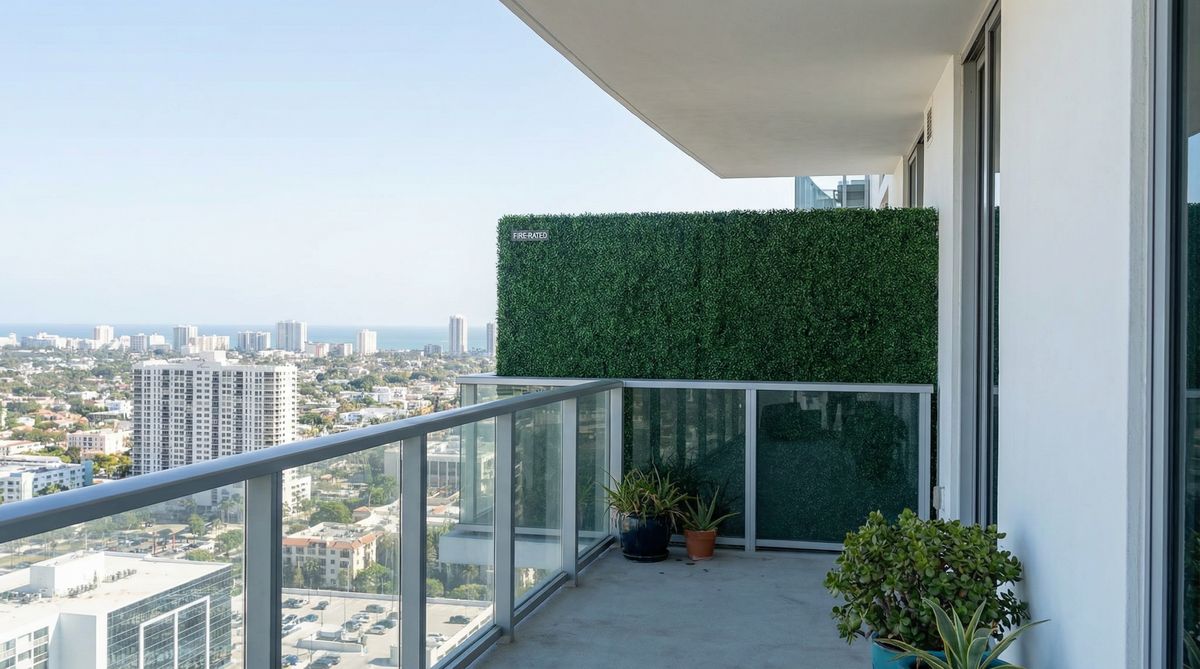
International Building Code (IBC) — The primary code governing building construction, including requirements for interior finishes and decorative materials. Texas cities adopt the IBC, typically with local amendments.
International Fire Code (IFC) — The companion code focused on fire prevention, fire protection systems, and ongoing building fire safety. The IFC addresses decorative materials and furnishings in occupied buildings.
Both codes are updated on a three-year cycle. Texas jurisdictions may adopt different editions—some cities are on the 2021 edition, others may still reference 2018 or earlier. Check with your city's building department for the specific edition in effect.
How the codes address decorative materials
IBC Chapter 8 — Interior Finishes. This chapter sets requirements for materials applied to walls, ceilings, and floors based on the building's occupancy type and sprinkler status. Interior finishes are required to be tested per ASTM E84 (or UL 723) and classified as Class A, B, or C based on their flame spread and smoke development characteristics.
IFC Chapter 8 — Interior Furnishings and Decorative Materials. This chapter addresses decorative vegetation, curtains, draperies, and other decorative materials in commercial spaces. It references NFPA 701 as the applicable test standard for flame propagation of decorative materials.
The distinction matters: if the artificial greenery is classified as an interior finish (applied to walls like a wall covering), IBC Chapter 8 and ASTM E84 may apply. If it's classified as a decorative material (freestanding or decorative element), IFC Chapter 8 and NFPA 701 are more likely to apply.
In most installations, artificial living walls and hedge panels are treated as decorative materials, making NFPA 701 the more commonly referenced standard. For a detailed comparison of the two standards, see our NFPA 701 vs ASTM E84 guide.
How occupancy type affects requirements
Planning a similar project?
Use these next pages while you read
They cover pricing, service details, and the next planning step without making you leave the article blind.
The IBC classifies buildings by occupancy type, and each type has different levels of fire code scrutiny. For artificial greenery, the key occupancy types are:
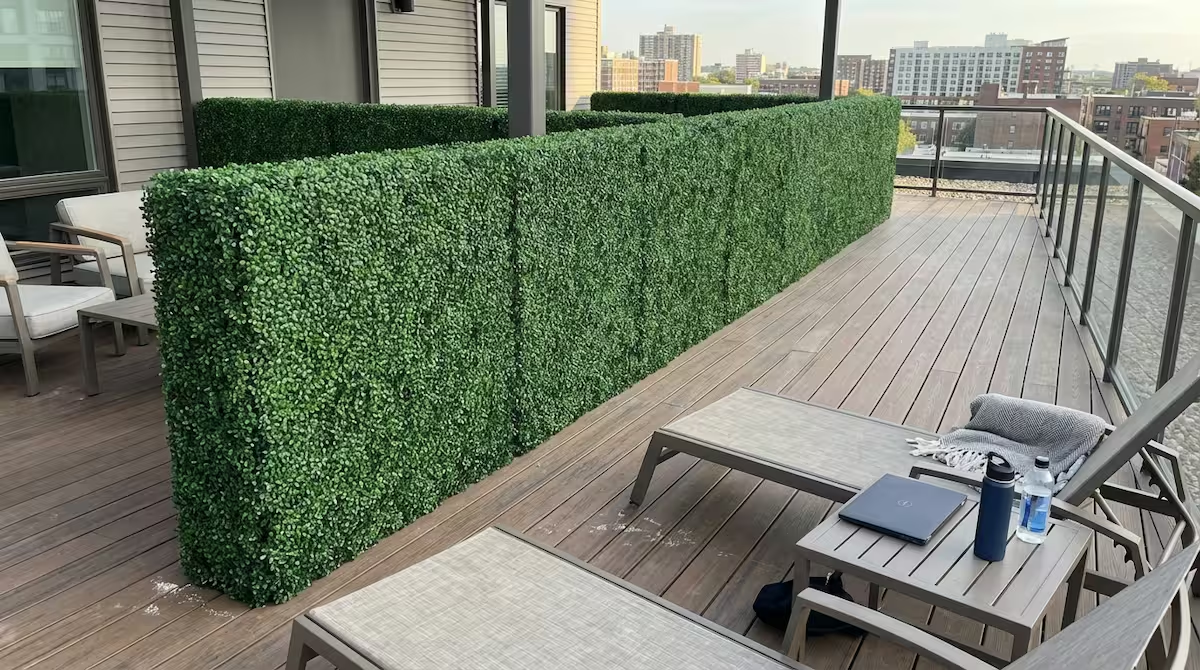
Assembly (Group A)
Restaurants, bars, event venues, churches, theaters, and any space designed for gatherings of people. Assembly occupancies face the strictest requirements for interior finishes and decorative materials because of the number of occupants and the potential for rapid fire spread in crowded spaces.
What this means: Artificial greenery in restaurant dining rooms, hotel ballrooms, event spaces, and similar assembly areas is most likely to require fire-rated documentation.
Business (Group B)
Offices, banks, professional services. Business occupancies have moderate requirements—less strict than assembly but still subject to interior finish standards.
Educational (Group E)
Schools and daycare facilities. Fire requirements are strict due to the occupant population (children). Decorative materials face scrutiny.
Institutional (Group I)
Hospitals, nursing homes, correctional facilities. The strictest fire requirements in the IBC because occupants may not be able to self-evacuate.
Mercantile (Group M)
Retail stores and shopping areas. Requirements are moderate, similar to business occupancies.
Residential (Group R)
Hotels (R-1), apartments (R-2), and other residential occupancies. Hotels face assembly-level scrutiny in common areas and lobbies. Apartment buildings face moderate requirements in common areas.
High-rise buildings
Any building with an occupied floor more than 75 feet above the lowest level of fire department vehicle access is classified as a high-rise under the IBC. High-rise fire codes add requirements beyond the base occupancy classification, including stricter standards for interior finishes and combustible materials. For more on high-rise applications, see our guide on fire-rated hedges for Texas high-rises.
Where requirements are most likely to apply
Based on the code framework and typical enforcement in Texas cities:
Most likely to require fire-rated documentation:
- Interior common areas in hotels and multifamily buildings (lobbies, hallways, amenity spaces)
- Restaurant and bar interiors and covered patios
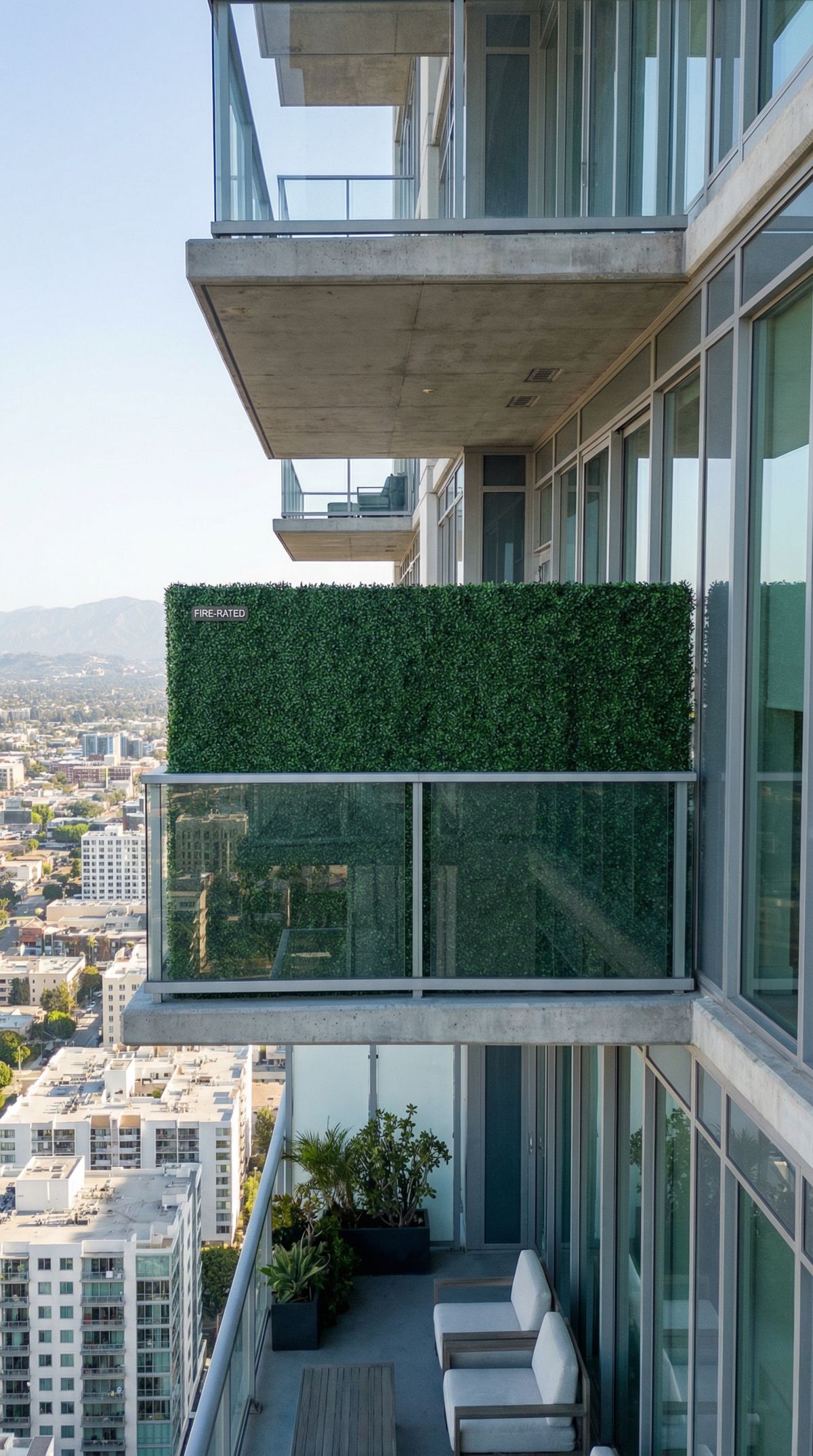
- High-rise balconies and common areas
- Spaces along egress paths (near exits, stairwells, corridors)
- Interior walls in assembly occupancies
May require documentation depending on the AHJ:
- Covered patios and semi-enclosed outdoor spaces
- Decorative elements near cooking equipment or heating sources
- Large-scale installations that cover significant wall area
Typically not required but still smart:
- Fully exterior fence-line installations
- Residential backyard installations
- Small accent pieces in business offices
The role of the AHJ
The Authority Having Jurisdiction—usually the city fire marshal or building official—is the person who decides how codes apply to your specific project. This is important because:
Codes are interpreted, not just applied. The same installation in the same building type may be treated differently by different AHJs. One fire marshal may require NFPA 701 documentation for a restaurant patio wall; another may not, depending on the degree of enclosure and their reading of the code.
Local amendments vary. Texas cities adopt model codes with local amendments that can add, modify, or remove requirements. What applies in Houston may differ from Austin, Dallas, or San Antonio.
Early communication prevents problems. A phone call or email to the AHJ during the design phase costs nothing and can save weeks of delays and thousands of dollars in material replacement if requirements aren't met. Ask: "We're installing artificial greenery in [describe location and building type]. Does the fire marshal's office have requirements for this type of material?"
How to prepare for inspection
Whether the fire marshal shows up during construction, during a certificate of occupancy inspection, or during a routine inspection years later, here's what to have ready:
1. Fire test report or certificate. A document from an accredited testing laboratory that names the specific product installed, the test standard (NFPA 701 Method 2, ASTM E84, etc.), and the result. The product name on the report should match what's on the wall.
2. Product specification sheet. Material composition, dimensions, manufacturer, and intended use (indoor/outdoor).
3. Installation documentation. How it was mounted, what fasteners were used, and the substrate. This matters because the fire test covers a specific product configuration—if the installation deviates significantly, the test results may not apply.
4. Maintenance records (if applicable). If the fire resistance comes from a topical treatment that requires reapplication, documentation that the treatment is current.
Keep all of this in a project file that's accessible to building management. Staff turns over; inspections don't follow a schedule.
For a complete documentation checklist, see our fire-rated artificial greenery guide for commercial properties.
Common mistakes that create problems
Not checking with the AHJ before installing. The greenery is up, the inspector arrives, and you don't have documentation. Now you're scrambling—or removing product.
Assuming "fire-rated" without documentation. A vendor saying "it's fire-rated" means nothing without a test report. Get the paperwork before you buy.
Using different products than what's documented. If the fire test covers Product A and you install Product B because it was cheaper or in stock, the documentation doesn't apply. The product on the wall must match the product on the test report.
Mixing documented and undocumented components. Attaching fire-tested panels with adhesives, backing materials, or frames that weren't part of the tested assembly can undermine the documentation.
Ignoring placement. Even with fire-rated products, placing artificial greenery directly adjacent to ignition sources (grills, heaters, cooking equipment, smoking areas) is a risk that documentation alone doesn't address. Maintain separation from heat and flame sources.
Related articles
This article is part of our fire-rated artificial greenery guide for Texas commercial properties, which covers standards, documentation, and procurement.
You might also find these useful:
For fire-rated products, see our fire-rated artificial hedge page or Vallum FRX system.
FAQ
Does Texas have a statewide fire code for artificial plants?
Texas does not have a single statewide fire code that specifically addresses artificial plants. Texas adopts the International Building Code and International Fire Code as base codes, but enforcement happens at the local level through city and county jurisdictions. Requirements vary by location, building type, and the Authority Having Jurisdiction.
Do all commercial buildings in Texas require fire-rated artificial greenery?
No. Requirements depend on the building occupancy type, where the greenery is installed, and local code enforcement. Assembly occupancies, high-rise buildings, healthcare facilities, and educational buildings face the most scrutiny. Fully exterior installations typically face less regulation than interior or semi-enclosed spaces.
What happens if I install non-fire-rated artificial greenery in a commercial building?
If a fire marshal or building inspector determines that fire-rated materials are required for your installation and you cannot produce documentation, you may be required to remove the greenery, replace it with compliant materials, or provide additional fire protection measures. This can happen during routine inspections, certificate of occupancy reviews, or complaint-driven investigations.
Who decides whether fire-rated materials are required?
The Authority Having Jurisdiction—usually the local fire marshal or building official—makes the determination based on applicable codes, the building type, and the specific installation. Early communication with the AHJ during the design phase is the most effective way to determine requirements before purchasing materials.
References
- International Code Council (IBC/IFC): https://www.iccsafe.org/
- NFPA 701: https://www.nfpa.org/codes-and-standards/nfpa-701-standard-development/701
- ASTM E84: https://www.astm.org/e0084-24.html
Need a next step?
Need fire-rated options or documentation?
Send the wall size, project type, and timeline. We can tell you when fire-rated foliage or documentation belongs in the scope.
Ready for the next step?
Use the page that fits your project best
Pick the shortest path based on whether you need pricing, a service page, or a local planning page.