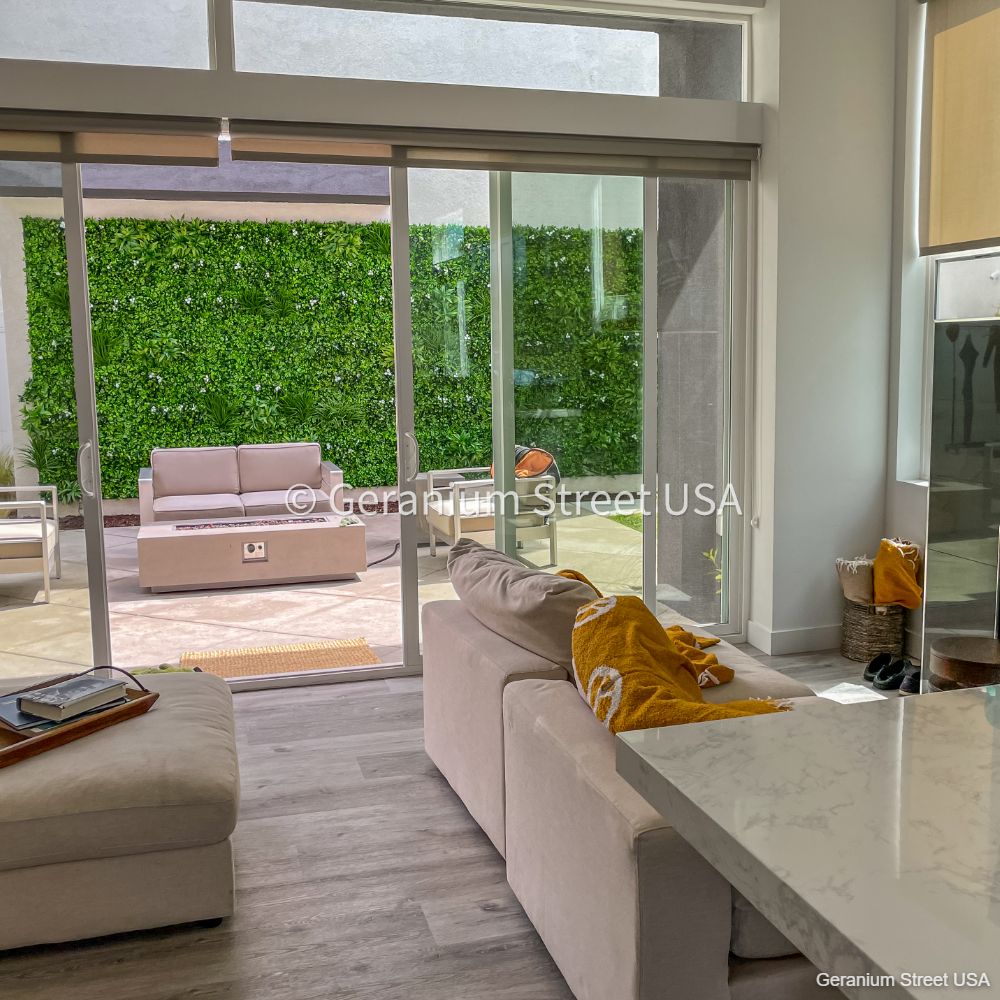
The material your artificial living wall is made from determines how it looks, how long it lasts, and how it handles the specific conditions Texas throws at it: intense UV, sustained heat, humidity along the coast, dust in Central Texas, and temperature swings between seasons.
This guide covers the materials that matter—from the foliage polymers to the backing grid to the screws holding it together—so you know what to look for and what to avoid.
Planning a similar project? See artificial living wall installs →.
Foliage materials
Polyethylene (PE)
Polyethylene is the industry standard for quality outdoor artificial greenery. It's the same polymer family used in outdoor playground equipment, agricultural films, and marine rope—applications where UV exposure and weather are constant.
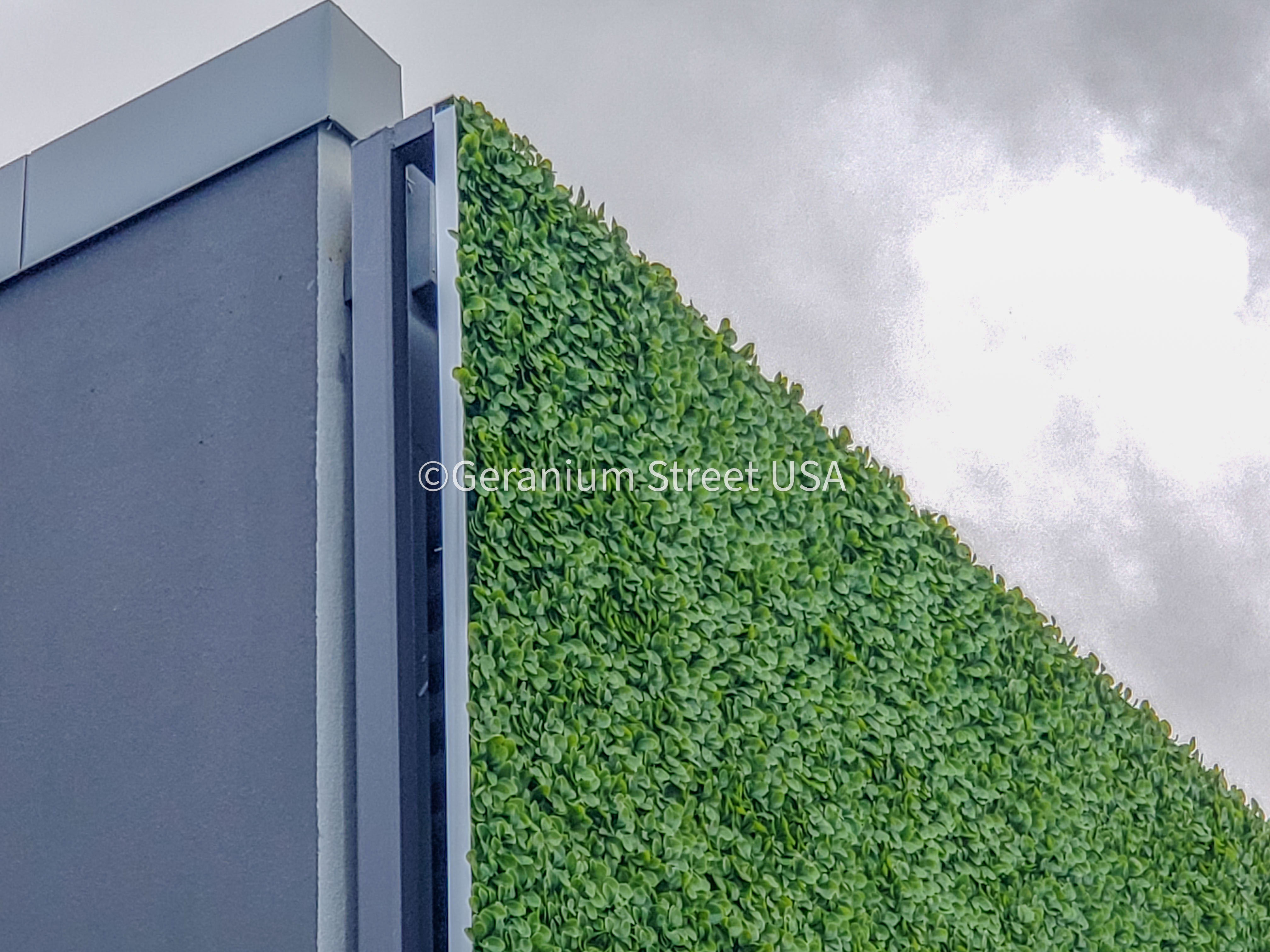
Why PE works for Texas:
- UV resistance. PE accepts UV stabilizer additives well, and UV-stabilized PE holds color and flexibility significantly longer than other polymers under solar exposure.
- Heat tolerance. PE maintains its flexibility and shape at temperatures well above what Texas summers produce. It doesn't soften, sag, or deform in heat.
- Realistic feel. PE has a softer, more natural hand-feel than PVC. Up close, PE foliage looks and feels more like a real leaf.
- Color retention. The molecular structure of PE holds dyes better under UV stress, which means less fading over time compared to PVC.
PE is more expensive to manufacture than PVC, which is why budget artificial greenery often uses PVC instead. For outdoor use in Texas, the PE premium is worth it.
PVC (polyvinyl chloride)
PVC is the budget alternative. It's stiffer, shinier, and less realistic than PE. More importantly for Texas outdoor use, PVC degrades faster under UV exposure.
What happens to PVC in Texas sun:
- Becomes brittle within a few years of direct sun exposure
- Fades and discolors faster than PE
- Can crack and shed leaves as the material hardens
- The shiny surface becomes chalky as it degrades
PVC has a place in indoor installations where UV exposure isn't a factor and budget is the primary concern. For any outdoor installation in Texas, specify PE.
Silk and fabric blends
Some artificial foliage uses silk or polyester fabric for a softer, more delicate look. These materials are fine for indoor accent pieces and arrangements but have no business on an outdoor wall in Texas.
Fabric foliage fades rapidly in direct sun, absorbs moisture, and breaks down quickly in heat. Even under a covered patio, the UV exposure in Texas is enough to degrade fabric foliage within a season or two.
Mixed material panels
Some living wall panels use a combination of PE for the primary foliage and other materials (PE film, fabric accents, or foam) for different leaf types within the same panel. This creates more visual variety—mixing ferns with grasses with trailing vines, each with different textures.
For outdoor use, verify that all materials in the panel are UV-stabilized, not just the primary foliage. A panel that's mostly UV-stabilized PE but includes non-stabilized accent leaves will develop visible degradation in those accent pieces first.
UV stabilization: the critical additive
Planning a similar project?
Use these next pages while you read
They cover pricing, service details, and the next planning step without making you leave the article blind.
UV stabilizers are chemical compounds added to the polymer during manufacturing. They work by absorbing, reflecting, or neutralizing UV radiation before it breaks down the polymer chains.
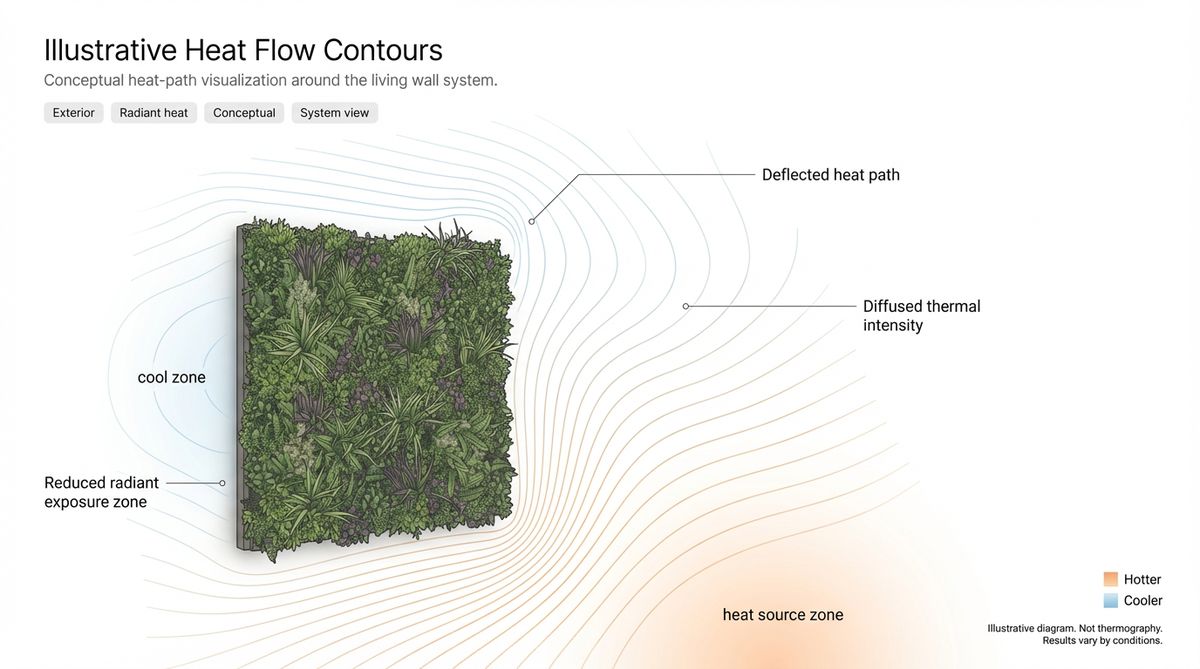
Types of UV stabilizers
HALS (Hindered Amine Light Stabilizers) are the most effective for long-term UV protection in polyethylene. They work by scavenging the free radicals that UV radiation produces in the polymer, interrupting the degradation cycle. HALS provide protection for years rather than months.
UV absorbers (like benzotriazoles) absorb UV radiation and convert it to heat. They're effective but deplete over time as they absorb UV energy. Products using only UV absorbers without HALS tend to have shorter outdoor lifespans.
The best products use both — HALS for long-term chain protection and UV absorbers for immediate UV filtering.
What the spec sheet should say
A quality outdoor panel's specification sheet should mention UV stabilization explicitly. Look for:
- "UV stabilized" or "UV resistant"
- UV protection rating or warranty period
- Intended use: "outdoor" or "indoor/outdoor"
If the spec sheet is silent on UV treatment, assume the product is indoor-only and will degrade quickly outdoors in Texas.
Backing grids and frames
The backing is what holds the foliage in place and takes the structural load when mounted. It's less glamorous than the foliage but equally important for longevity.
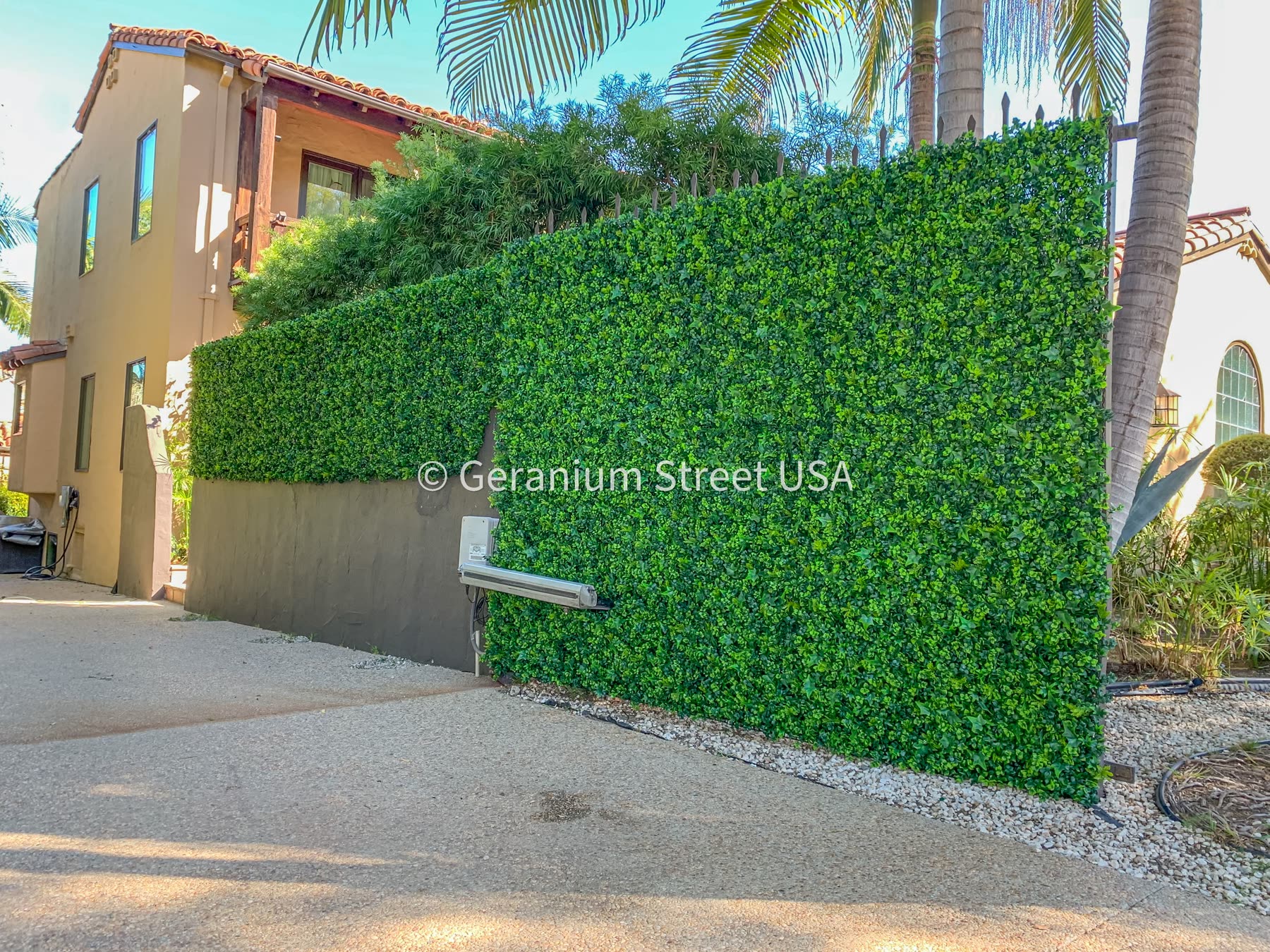
Rigid plastic grids
Most artificial living wall panels use a molded plastic grid as the backing. Quality matters here:
- Rigid, thick grids maintain their shape, provide solid attachment points, and resist warping in heat
- Thin, flexible grids sag over time, make panel alignment difficult, and flex in wind, stressing attachment points
For outdoor use, the grid material should also be UV-stabilized. A non-stabilized backing grid can become brittle and fail even if the foliage itself holds up.
Metal frames
Commercial and large-scale installations often use an aluminum or galvanized steel frame as the mounting structure, with panels attached to the frame. This approach provides:
- A flat, consistent mounting plane across large areas
- The air gap needed for heat and moisture management behind the panels
- Structural strength to resist wind load
- Independence from the wall surface condition
Aluminum is lighter and naturally corrosion-resistant. Galvanized steel is stronger and less expensive. For coastal Texas installations, aluminum or stainless steel is the safer choice because of salt air corrosion.
Interlocking edges
How panels connect to each other matters for appearance. Panels with interlocking edges create seamless transitions where foliage overlaps the joints between panels, hiding the grid lines. Without this, every panel boundary is visible—which breaks the continuous garden look.
Check how panels interlock before ordering. Test-fit two panels together if possible.
Fasteners and hardware
This is where many installations cut corners—and pay for it within a year or two.
Zip ties
The most common attachment method for residential installations. The critical distinction:
- UV-rated (black) zip ties contain carbon black or UV stabilizers that resist sun degradation. They last several years outdoors.
- Standard (white or natural) nylon zip ties become brittle in Texas sun within 6 to 12 months and snap.
Always use UV-rated zip ties for outdoor installations. They cost marginally more and last dramatically longer.
Screws
For more permanent attachment:
- Stainless steel screws resist corrosion in all Texas conditions including coastal humidity and pool environments
- Coated screws (galvanized, ceramic-coated, or deck screws) are a step up from bare steel but may corrode over time in harsh environments
- Bare steel screws will rust, stain the panels and mounting surface, and eventually fail
Anchors
For mounting to masonry, concrete, or stucco:
- Concrete sleeve anchors or tapcon screws for direct mounting
- Toggle bolts for hollow block or brick with cavities
- Use the same corrosion-resistant principle—stainless or coated
Adhesives
Some installers use adhesive for quick attachment. For outdoor use in Texas, adhesives are risky:
- Heat softens most adhesives
- Moisture and humidity undermine bonding
- UV degrades adhesive chemistry over time
If adhesive is part of the plan, it should supplement mechanical fasteners, not replace them.
Putting it together: what to specify for Texas outdoor use
For an outdoor living wall installation in Texas, the material specification should include:
- UV-stabilized polyethylene foliage — not PVC, not fabric
- UV-stabilized backing grid — rigid, with interlocking edges
- Stainless steel or coated fasteners — no bare steel, no standard zip ties
- Mounting system with air gap — furring strips, grid, or frame to prevent heat and moisture buildup behind panels
- Fire-rated option if commercial — tested to NFPA 701 Method 2 for installations that require fire compliance
Related articles
This article is part of our complete guide to artificial living walls in Texas, which covers applications, installation, and maintenance.
You might also find these useful:
For product options, see our living wall page or commercial living wall page.
FAQ
What material is best for outdoor artificial living walls in Texas?
UV-stabilized polyethylene (PE) is the best material for outdoor use in Texas. It resists UV degradation, handles heat without becoming brittle, holds color longer than alternatives, and feels realistic. Avoid PVC for outdoor applications—it degrades faster under UV and heat.
How do I know if a living wall panel is UV-stabilized?
Check the product specification sheet. It should explicitly state UV stabilization or UV resistance. If the spec sheet does not mention UV treatment, ask the manufacturer directly. Products without UV stabilization should only be used indoors.
Do the fasteners and hardware matter for the lifespan of a living wall?
Yes. Foliage and hardware can age at different rates, so use corrosion-resistant fasteners and outdoor-rated attachment methods. Cheap hardware often fails long before the foliage is ready to be replaced.
Can I mix different panel types on the same wall?
Yes, mixing panel types is a common design technique for creating visual variety. Make sure all panels share the same outdoor rating (UV-stabilized, weather-rated) and that the backing systems are compatible for consistent mounting.
Need a next step?
Planning a similar Texas project?
Use this article for research, then send your dimensions, city, and photos if you want a useful next step.
Ready for the next step?
Use the page that fits your project best
Pick the shortest path based on whether you need pricing, a service page, or a local planning page.